
Criminal Cases in the Effingham County Courts
Effingham County Superior Court hears felony cases as part of the Ogeechee Judicial Circuit. State Court hears misdemeanors, traffic offenses, and other limited matters. Magistrate Court handles warrants, initial and preliminary functions, and bail except where authority belongs elsewhere. Rincon, Springfield, and Guyton municipal courts retain city ordinance and traffic matters plus limited state-law cases.
The Clerk of Superior, State and Juvenile Courts is the custodian for county Superior and State Court files. The criminal desk is in Suite 110 at the Effingham County Judicial Complex, 700 North Pine Street, Springfield. Municipal citation files stay with the city court unless a different charge proceeds in a county court.
| Court | Criminal role | Contact |
|---|---|---|
| Superior Court | Felony trial files and indictments | 912-754-2146 |
| State Court | Misdemeanors and traffic | 912-754-2163 |
| Magistrate Court | Warrants, bail, preliminary matters | 912-754-2124 |
| Municipal courts | City citations and ordinances | Contact the named city court |
Calling the Effingham County Criminal Desk
The clerk’s civil and criminal number is 912-754-2146. Published hours are Monday through Friday, 8:00 a.m. to 5:00 p.m., excluding national holidays. Have the defendant’s full name, case number if known, approximate filing year, and the court or charge level ready. Ask for the docket and final disposition first, then the charging document, sentence, or certified copy if those are needed.
No official online per-page copy fee was located. Ask the clerk for the current copy and certification quote before ordering. The clerk can also explain whether an older Effingham County criminal case is in an archived or paper collection. A written agency open-records request is not a substitute for asking the court clerk for judicial records.
Superior, State and Juvenile Court Clerk
700 N Pine St., Suite 110
Springfield, GA 31329
Criminal:
912-754-2146
Mon-Fri, 8:00-5:00
How to Search Case Records
Georgia has no single comprehensive free trial-court portal covering every Effingham County case. The clerk site and calendar are useful starting points, but direct clerk contact is the main fallback for a complete docket, disposition, archived file, or certification. A calendar shows scheduled activity, not a conviction or final outcome.
- Open the official clerk site or calendar and determine whether the matter is Superior or State Court.
- Search or call with the case number; without it, provide the full name and approximate year.
- Use date of birth only where available and lawful to distinguish common names.
- Request the docket and final disposition, then identify the exact documents needed.
- Ask the clerk for copies, certification, archive retrieval, and the current fee quote.
| Field Label | Type | Required | Notes |
|---|---|---|---|
| Case number | Text | No, but best | Ask the clerk for the local format. |
| Defendant full name | Text | Yes without case number | Include middle name or aliases. |
| Date of birth | Date | No | May help distinguish names; access can be limited. |
| Court | Selection | Yes | Superior, State, or municipal. |
| Filing year range | Dates | No | Useful for archive searches. |
| Record type | Selection | No | Docket, charge, disposition, sentence, or certified copy. |
Reading the Effingham County Court Calendar
The clerk’s calendar can establish that a hearing or court session is scheduled. It does not establish that the hearing occurred, that a plea was entered, or that a case reached a final result. Calendars can change, and an entry may remain useful for courtroom and date information even when the underlying outcome must be obtained from the docket.
The official clerk calendar shows the public interface used to review scheduled court activity.
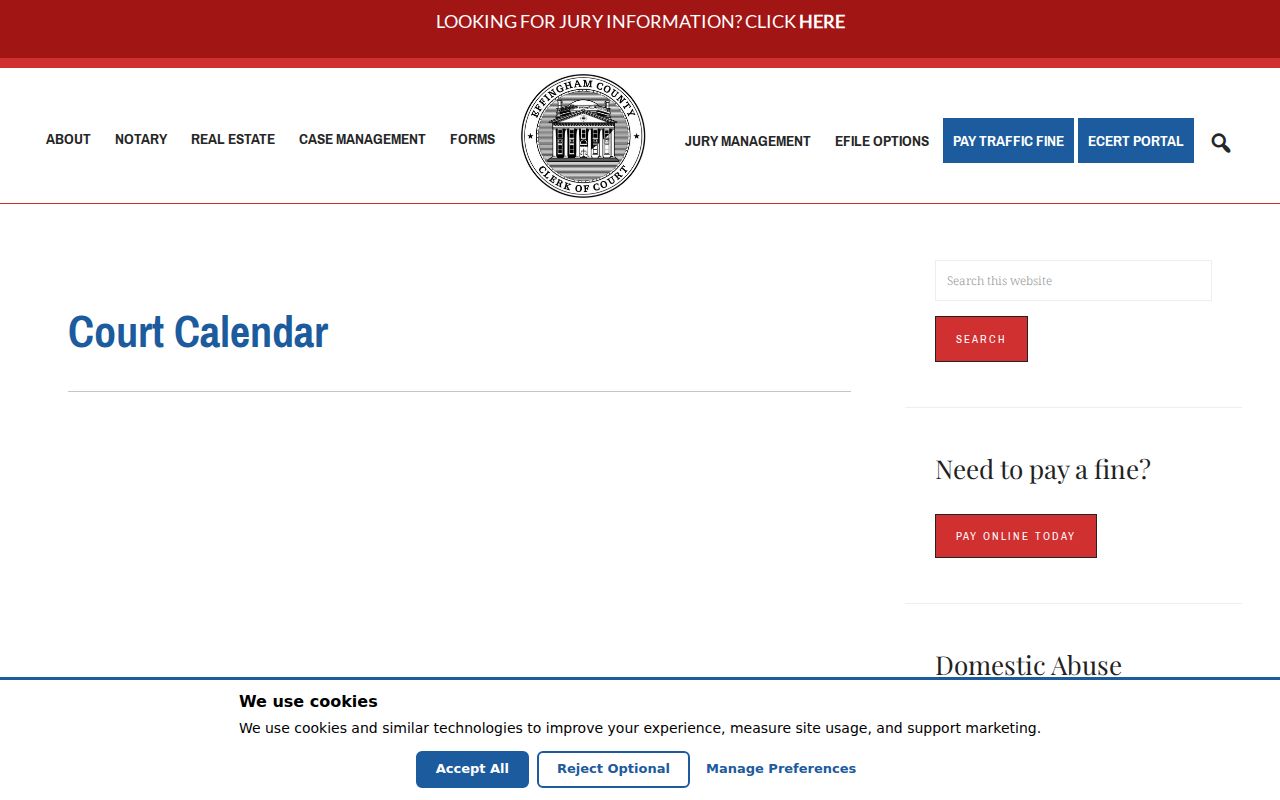
After locating an Effingham County criminal case on the calendar, call the criminal desk and request the filed docket plus the final disposition rather than treating the calendar entry as the result.
What the Case File Shows
An Effingham County criminal case file documents the prosecution after charges are filed. It may show the State of Georgia and defendant, counsel, count-level charges, motions, hearings, bond filings, pleas, judgment, sentence, and later revocation activity. Document availability varies, and confidential fields are redacted.
| Case Number & Court | Filing date, court, case type, assigned judge or division, and status. |
|---|---|
| Charging Document | Accusation or indictment, count descriptions, statutes, and classification. |
| Docket Entries | Filed events such as arraignment, motions, hearings, plea, trial, judgment, and warrants where public. |
| Hearing Dates | Date, time, courtroom, and judge as recorded; later entries confirm what occurred. |
| Disposition & Judgment | Dismissal, nolle prosequi, acquittal, plea, verdict, First Offender treatment, or other outcome. |
| Sentence & Conditions | Confinement, probation, fines, conditions, and filed modifications or revocations. |
Why Effingham County Booking Charges Change
A booking charge reflects what law enforcement presented at intake. It is not necessarily the count that a prosecutor files. The District Attorney prosecutes Superior Court felonies in the Ogeechee Judicial Circuit, while the Solicitor-General prosecutes State Court misdemeanors. Review may lead to a different charge, fewer counts, no filed case, or a later dismissal.
For that reason, match a booking entry to the accusation or indictment and then to the count-level disposition. The Effingham County arrest history channels explain custody and agency records; the court file is the source for prosecution and judgment. If no court case appears soon after arrest, timing alone does not prove that the matter was dropped.
Stages of a Criminal Case
An Effingham County felony can begin with arrest and a Magistrate Court appearance before the filed case proceeds in Superior Court. Misdemeanors generally proceed in State Court, while a city citation may remain municipal. Discovery, motions, negotiated pleas, trial preparation, and scheduling make the length of any case fact-specific; the research supports no fixed county timetable.
Case flow: Charges Filed › Arraignment › Pretrial › Plea or Trial › Disposition › Sentencing
Appeal, probation modification, or revocation entries can follow sentencing. A first appearance or bond ruling is not the trial disposition, and the charge named at that stage can still change.
Effingham County Disposition Terms
Short docket terms carry different legal meanings. Reading them as synonyms can turn a correct court entry into a false conclusion about the Effingham County case.
- Dismissal
- The charge ends without a conviction on that count.
- Nolle prosequi
- The prosecutor formally declines to continue the charge at that time; it is not an acquittal.
- Acquittal
- A not-guilty result after trial.
- Dead docket
- The prosecution is placed inactive and is not the same as a guilty judgment.
- First Offender
- A qualifying Georgia process that can lead to discharge and exoneration after successful completion.
- Disposition
- The official outcome recorded for a charge.
A disposition should be read count by count. One case can contain a conviction on one count and a dismissal on another.
Municipal or Effingham County Criminal Case?
Rincon, Springfield, and Guyton municipal courts retain their own citation and ordinance files. Rincon Municipal Court is at 107 West 17th Street and can be reached at 912-826-5665. Springfield’s Police/Court Clerk is at 130 South Laurel Street, 912-754-3061. Guyton’s Clerk of Court handles citation records at 912-772-3353, with court held on the first Wednesday of each month at the Guyton Gymnasium.
Start with the court named on the citation. If prosecution proceeds as a county misdemeanor or felony, use the Effingham County clerk for the State or Superior Court file. A city police report remains with the city even when the resulting criminal charge moves to a county court. County E-911 holds CAD and call audio for the three city police departments, not the judicial case file.
Access & Restrictions
Adult Effingham County court records are generally open unless a statute, court order, or confidentiality rule limits access. Juvenile files, sealed First Offender matters, victim or minor information, Social Security numbers, financial-account data, and restricted or sealed material are not ordinary public products. An online view can also omit documents that are available only through the clerk.
If an expected case does not appear, verify spelling, filing year, and court, then ask about archived or paper records. Ask the clerk whether the case is sealed or otherwise restricted, but do not expect protected details to be disclosed. Georgia record restriction limits eligible GCIC disclosure, while court sealing is a related and distinct step. A missing online result does not prove that no record exists.
When an Effingham County Outcome Is Missing
The court, prosecutor, or supervision agency must report final dispositions to GCIC. A missing or late submission can leave a statewide history showing an unresolved arrest after the Effingham County court has acted. Obtain the certified or file-stamped disposition from the clerk and contact the contributor that owns the missing segment.
Identity disputes may require fingerprints. GBI correction instructions can use name, date of birth, arrest date, SID, or OTN to identify the cycle. The jail cannot change a judicial disposition, and GCIC does not replace the underlying clerk file. Correct the source record first, then confirm the repository update.