
How to Check Criminal History in Effingham County
Begin by deciding whether the goal is to find current custody, a filed Effingham County court case, a police narrative, or a statewide Georgia conviction record. The county does not publish one complete criminal-history screen. The Effingham County Clerk of Superior, State and Juvenile Courts holds adult Superior and State Court files, while the sheriff holds its own reports and jail records.
Gather the full legal name, spelling variants, approximate date range, and case, report, booking, OTN, or citation number if known. Date of birth can help distinguish common names where its use and release are allowed.
- Check the Booking Desk for a recent arrest or current jail status.
- Call the clerk’s criminal desk or visit Suite 110 for filed charges and outcomes.
- Identify the arresting agency and request its incident or arrest narrative.
- Use Georgia Felon Search only for its narrower public felony-conviction scope.
- Ask the record holder for copies, certification, archive retrieval, or correction steps.
| Channel | Best answer | Key limit |
|---|---|---|
| Booking Desk | Recent custody, initial charge, bond | Not the final outcome |
| Effingham clerk | Filed charge, docket, disposition, sentence | Not a statewide history |
| Arresting agency | Incident and arrest narrative | Does not prove conviction |
| Georgia Felon Search | Public Georgia felony convictions | Not all arrests or misdemeanors |
Three Effingham County Records, Three Answers
A booking entry, court file, and GCIC history describe different stages. Effingham County jail intake records the charge presented at custody. A prosecutor may amend, replace, or decline that charge. The clerk then records the accusation or indictment, hearings, plea or trial result, and sentence. GCIC builds a statewide lifecycle from data sent by arresting agencies, prosecutors, courts, and corrections.
That flow explains why records can disagree without any one screen being fraudulent. A recent jail entry may precede a court case. A court dismissal may not yet appear in the repository if the disposition has not been sent. The best practice is to read the booking as an allegation, the filed case as the prosecution record, and the final judgment as the authoritative outcome.
Official Georgia Background Checks
The Georgia Bureau of Investigation’s Georgia Crime Information Center maintains the state computerized repository. Georgia Felon Search is a paid, name-based public product limited to available Georgia felony-conviction information. Its search requires full name, date of birth, race, sex, and acceptance of payment and use terms. It is not a free statewide rap sheet.
A broader history of another person generally requires signed consent under Georgia law. For one’s own record or an authorized fingerprint purpose, local law enforcement and the Georgia Applicant Processing Service are the better routes. GAPS uses an authorized service code, registration, a scheduled IdentoGO appointment, photo identification, and the fee shown for that service. Results generally go to the authorized agency in 24 to 48 hours after fingerprint submission.
| Georgia Felon Search field | Required | Use |
|---|---|---|
| First and last name | Yes | Exact legal spelling |
| Middle name | No | Narrows likely matches |
| Date of birth | Yes | Identity matching |
| Race and sex | Yes | State-required identifiers |
| Terms and payment | Yes | Runs the transaction |
Effingham County Records Start at Suite 110
The main court-record counter is the Clerk of Superior, State and Juvenile Courts at the Effingham County Judicial Complex, 700 North Pine Street, Suite 110, Springfield, GA 31329. The civil and criminal desk is 912-754-2146. Published clerk hours are Monday through Friday, 8:00 a.m. to 5:00 p.m., excluding national holidays.
The building’s floor plan saves a wasted trip. The clerk is on the first floor. Magistrate Court, which handles warrants, first appearances, preliminary functions, and much bail work, is in Suite 250 on the second floor. Superior Courtrooms named Ebenezer and Treutlen are on the third floor. A person seeking an Effingham County disposition should start at the clerk rather than a courtroom.
The official county court page shows how the current complex is organized. It also lists screening rules for visitors.
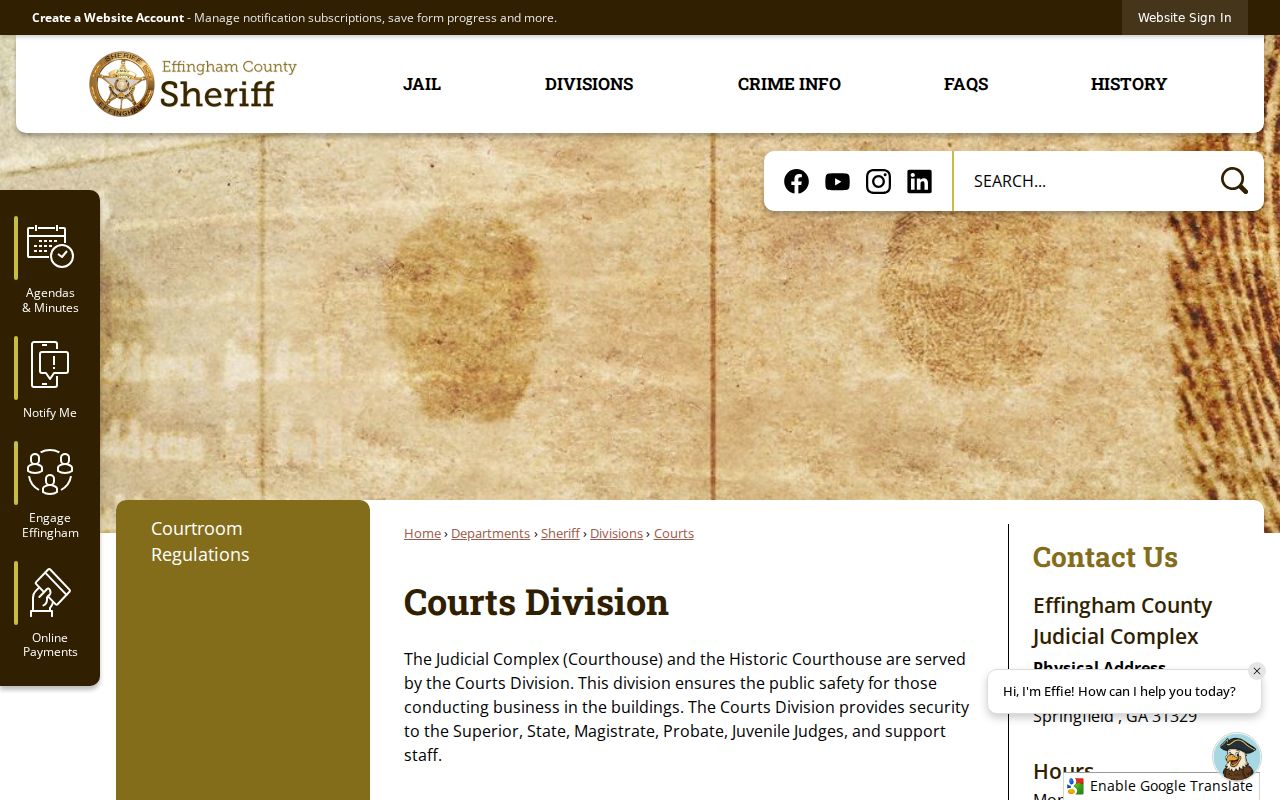
The modern complex, rather than the historic 1908 courthouse, is the working location for current criminal case retrieval.
Types of Criminal Records
Effingham County criminal records are defined as much by who creates them as by what they contain. Asking the right custodian prevents a request from being bounced between offices.
- Incident and arrest reports describe the event and belong to the sheriff, city police, state patrol, or other creator.
- Booking records show jail intake, original charges, bond, and release data, but not guilt.
- Court files contain filed charges, dockets, orders, pleas, judgments, and sentences.
- GCIC histories combine reportable Georgia arrest cycles and dispositions submitted by agencies.
- Custody and registry records cover jail, prison, parole, and sex-offender registration status within their own limits.
Warrants require extra care because Effingham County has no verified comprehensive public active-warrant list. Real-time status should be checked with the sheriff, the relevant court, or Magistrate Court.
The Effingham County Dispatch Split
One of the county’s most useful local distinctions concerns 911 and CAD records. Effingham Emergency Communication Services dispatches Fire, EMS, Rincon Police, Springfield Police, and Guyton Police. The Sheriff’s Office dispatches sheriff calls in the unincorporated county. A city police report still comes from that city department, but city call audio or CAD data goes through county E-911.
E-911 is at 181 Recycle Way in Guyton and can be reached at 912-754-8119. Its published policy says records retained for public inquiries cover three years, while the open-records request itself is retained seven years. A focused request should name the date, approximate time, place, responding agency, incident number if known, requested audio or CAD, and preferred format. Sheriff dispatch material follows the sheriff’s separate records route.
What an Effingham County Criminal Record Shows
A Georgia criminal history can include an identification segment, arresting agency and arrest date, charges, final judicial dispositions, and correctional custody data. An Effingham County case file adds the court-specific documents behind those summary entries. Protected identifiers are redacted from public copies.
| Name & Identifiers | Legal and alias names, date of birth, and physical descriptors where lawfully released; SSNs are protected. |
|---|---|
| Arrest / Booking Data | Agency, date, initial allegations, booking number, bond, custody, and release fields. |
| Charges & Statutes | Count descriptions, Georgia code references, and felony or misdemeanor classification. |
| Disposition | Dismissal, nolle prosequi, plea, verdict, acquittal, or other final status. |
| Sentence | Confinement, probation, fines, conditions, and filed revocation activity. |
| Custody / Supervision | County jail, GDC, probation, or parole information within the source’s scope. |
What the Effingham County Booking Desk Proves
The sheriff’s official Booking Desk is the first check for a recent Effingham County arrest. The jail is at 500 West First Street in Springfield, and the jail number is 912-754-9715. A booking result can show a booking number and time, custody status, charge descriptions, arresting agency, bond, and release information, depending on the current public interface.
It does not show that the person was convicted. A charge can change after a prosecutor reviews the report, and release does not mean the case ended. If the web roster is empty, call the jail because delayed intake, spelling, medical transport, quick release, or transfer can affect the display. For an older record, submit a focused sheriff request; for the outcome, use the Effingham County criminal court case file.
Public Access Laws
Georgia separates agency records, court files, and compiled criminal-history information. The Georgia Open Records Act supports access to existing agency records subject to exemptions. Judicial filings are requested from the clerk, while GCIC products follow the criminal-history dissemination statute and agency rules.
Key statutes and rules:
O.C.G.A. §50-18-70 et seq. supports access to agency records while allowing exemptions and reasonable production charges.
O.C.G.A. §35-3-34 governs consent-based criminal-history release and public felony-conviction access.
O.C.G.A. §35-3-37 establishes record restriction for eligible arrests and outcomes.
O.C.G.A. §42-8-60 addresses First Offender discharge and exoneration.
Georgia Rules Chapter 140-2 governs agency reporting and GCIC dissemination.
Juvenile information, active-investigation material, sealed files, victim data, medical information, and security-sensitive details may be limited. A custodian should identify the legal basis for withheld material.
Effingham County Sheriff Record Requests
The Effingham County Sheriff accepts records requests in the administration lobby at 500 West First Street, Springfield. The central number is 912-754-3449, and the published records contact is Tonya Hodges at thodges@effinghamcounty.org. Request sheriff-created incident reports, sheriff arrest reports, jail records, and sheriff dispatch material there.
Include requester contact details, a narrow record description, the incident, case, or booking number if known, date and time range, location, named agency, and preferred delivery format. No comprehensive sheriff fee schedule, fixed turnaround, or general ID requirement was found in the official research. Ask for an estimate if retrieval or redaction may be substantial and request an electronic copy where practical. Court pleadings belong to the clerk, while Rincon, Springfield, and Guyton reports belong to their police channels.
Sealed, Expunged & Restricted
Georgia uses the term record restriction, not literal erasure. An eligible GCIC entry can be limited from noncriminal-justice disclosure, while authorized criminal-justice access remains. A separate court sealing step may be needed to limit access to the courthouse file. Ordinary eligible outcomes can include dismissal, no further action, nolle prosequi, dead docket, or no record on file; a guilty disposition does not qualify under the standard non-conviction process.
For arrests after July 1, 2013, the GBI directs the person to the prosecutor. Older arrests use a three-part form completed by the subject, arresting agency, and prosecutor, followed by a $25 GCIC processing fee paid in the prescribed form. Missing dispositions should be fixed with the clerk or prosecutor before restriction. First Offender discharge and sealing follow a distinct statutory path.
Fixing a Missing Effingham County Disposition
An Effingham County arrest may appear unresolved in GCIC even though the local case ended. Courts, prosecutors, and supervision agencies report final dispositions, and a late or missing submission can break the lifecycle. Start with a copy of the Effingham County docket and final disposition from the clerk. Then ask the office that owns the inaccurate segment to send or correct the data.
GBI correction instructions use identifiers such as name, date of birth, arrest date, SID, or offender tracking number. A fingerprint comparison may be required when the dispute concerns identity rather than a missing court result. Do not ask the jail to amend a court judgment or ask the clerk to rewrite a police narrative. Each custodian corrects its own record.
Effingham County Custody After Jail
The county booking interface is for recent local custody. A person sentenced to state prison belongs in GDC Find an Offender, which can be searched with fields such as name, GDC ID, sex, race, age, or conviction county. The Georgia State Board of Pardons and Paroles provides parole tools, while the Department of Community Supervision oversees adult felony probationers and parolees in the community.
A visible bond amount does not always mean release is available. Another count may carry a hold or no-bond condition. Ask the jail or issuing court whether the amount is aggregate or per count, what type of bond is authorized, and whether another agency’s hold applies.
A Growing Effingham County Records System
Effingham County’s July 2025 Census estimate was 74,397, up 14.8 percent from the 2020 estimates base. The county spans 478.8 square miles and divides criminal records among the modern Judicial Complex, sheriff and jail, three municipal systems, and state services. Growth provides context for the split, but it must not be presented as proof of more crime.
Official crime statistics should be queried by agency and year through GBI or the FBI Crime Data Explorer. Effingham County Sheriff totals cannot simply be added to or substituted for Rincon, Springfield, or Guyton police figures because agency coverage differs. Reported offenses are also not convictions.
Criminal Records by City in Effingham County
Rincon, Springfield, and Guyton are Effingham County’s three incorporated cities. Their police departments create local reports, their municipal courts retain citation files, and county E-911 holds city police CAD and call audio. County jail and Superior or State Court records remain separate.
Rincon Criminal History
Rincon Police records and two monthly Municipal Court dockets.
Springfield Criminal History
City Police/Court Clerk records beside separate county offices.
Guyton Criminal History
One clerk handles police requests, citations, and monthly court data.